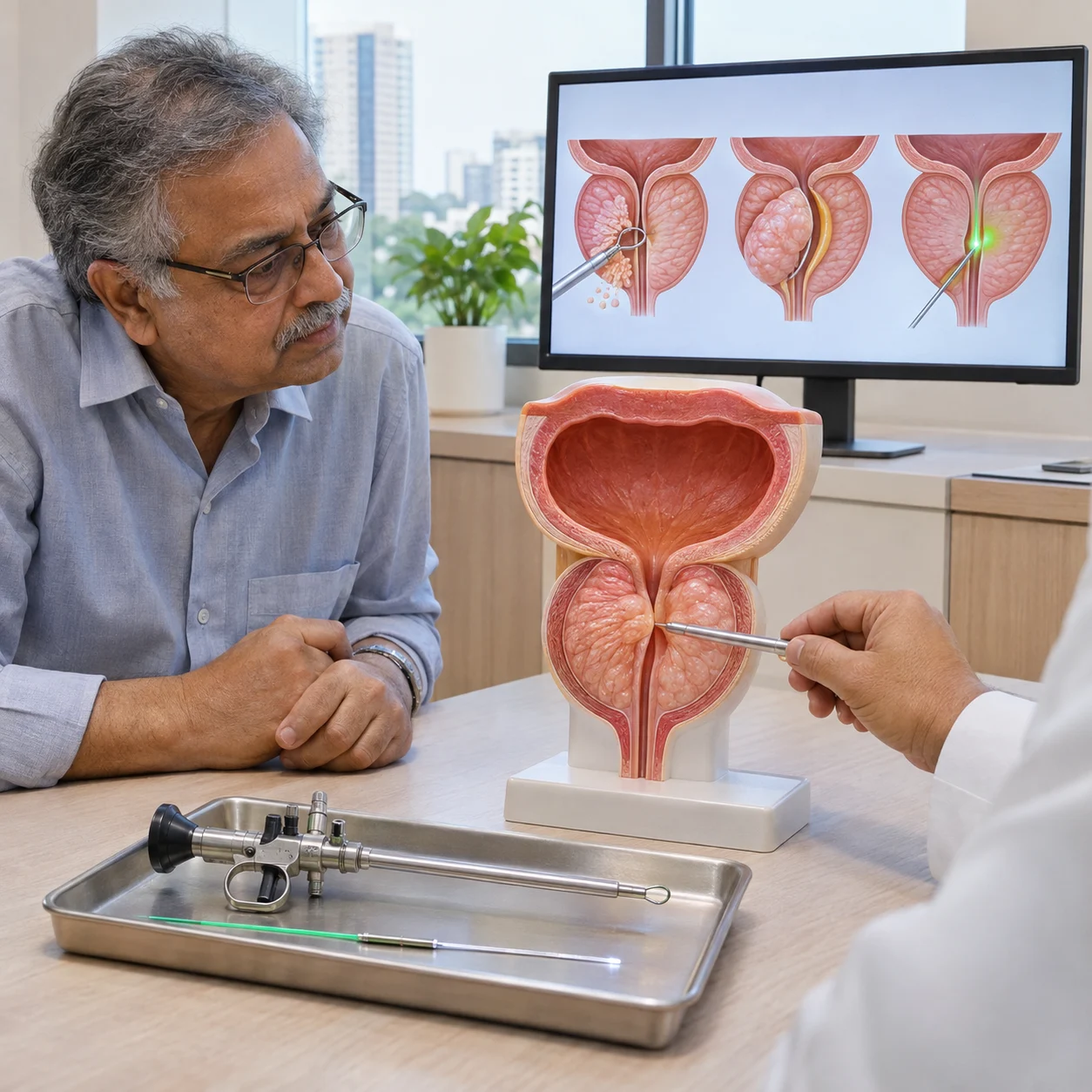
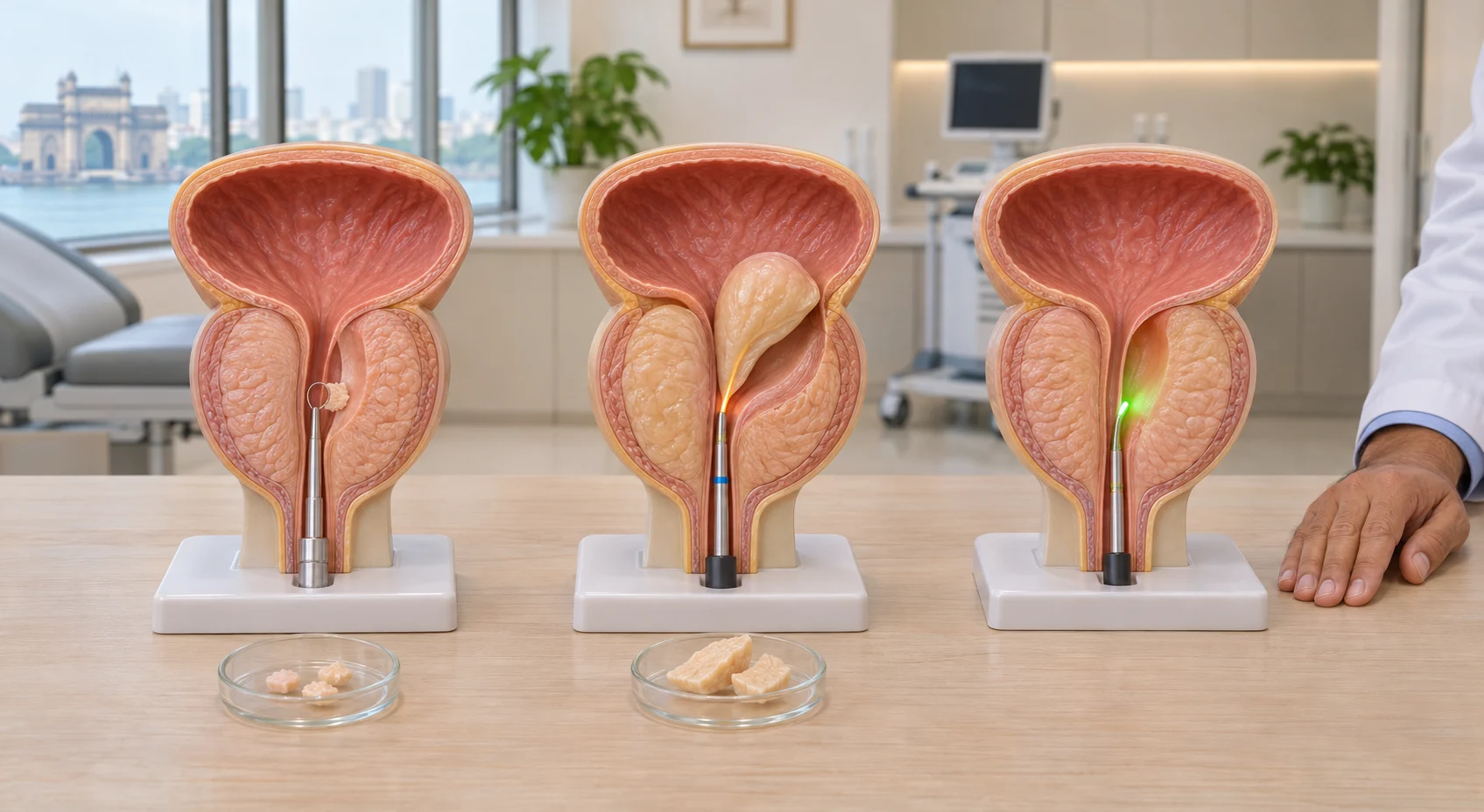
If your urologist has suggested “TURP or laser” for an enlarged prostate, ask which laser procedure they mean. TURP uses an electrical loop to shave away tissue blocking urine flow. HoLEP uses a laser to separate and remove the enlarged inner tissue. GreenLight laser surgery vaporises the tissue. All three work through the urethra, the tube you pass urine through, and usually require no skin incision.
The distinction matters. If your prostate is particularly large, one technique may suit its size better. If you take a blood thinner, bleeding risk may carry more weight. And if you want to know whether tissue will be available for laboratory testing, the answer depends on the operation.
TURP, HoLEP and GreenLight at a glance
| Patient question | TURP | HoLEP | GreenLight PVP |
|---|---|---|---|
| How does it open the channel? | An electrical loop removes small pieces of prostate tissue. | A holmium laser frees the enlarged inner tissue. The surgeon then breaks it into smaller pieces for removal. | A laser heats and vaporises tissue to widen the channel. PVP means photoselective vaporisation of the prostate. |
| Does prostate size matter? | An established option for glands around 30–80 mL. | Used across a wide range of sizes, including glands larger than 80 mL. | Commonly considered for glands around 30–80 mL. Larger glands need an individual assessment. |
| Can tissue be tested? | Yes. The pieces can go to the laboratory. | Yes. The removed tissue can go to the laboratory. | Standard vaporisation usually leaves no sample. |
| How does bleeding risk compare? | Bleeding can occur. The type of TURP also matters. | Often causes less blood loss than TURP. | The laser seals small blood vessels as it works. Transfusion is less common than with traditional monopolar TURP. |
| Will I need a catheter? | Usually, while swelling and bleeding settle. | Usually, often for a short period. | Usually, sometimes only overnight. |
Prostate volume on an ultrasound report may appear in cc instead of mL. A reading of 65 cc means 65 mL. These size ranges guide the discussion. They cannot tell you by themselves whether you need surgery.
When does an enlarged prostate need surgery?
Benign prostatic hyperplasia (BPH) is non-cancerous prostate enlargement. As the prostate grows around the urethra, you may notice a weaker stream, a delay before urine starts or the feeling that your bladder is still full. If symptoms are manageable and the bladder empties adequately, monitoring or medicines may be enough.
Surgery becomes worth discussing when symptoms disrupt daily life despite treatment, or when the blockage causes complications. Examples include repeated inability to pass urine, recurrent urinary infections linked to poor emptying, bladder stones or kidney problems caused by obstruction.
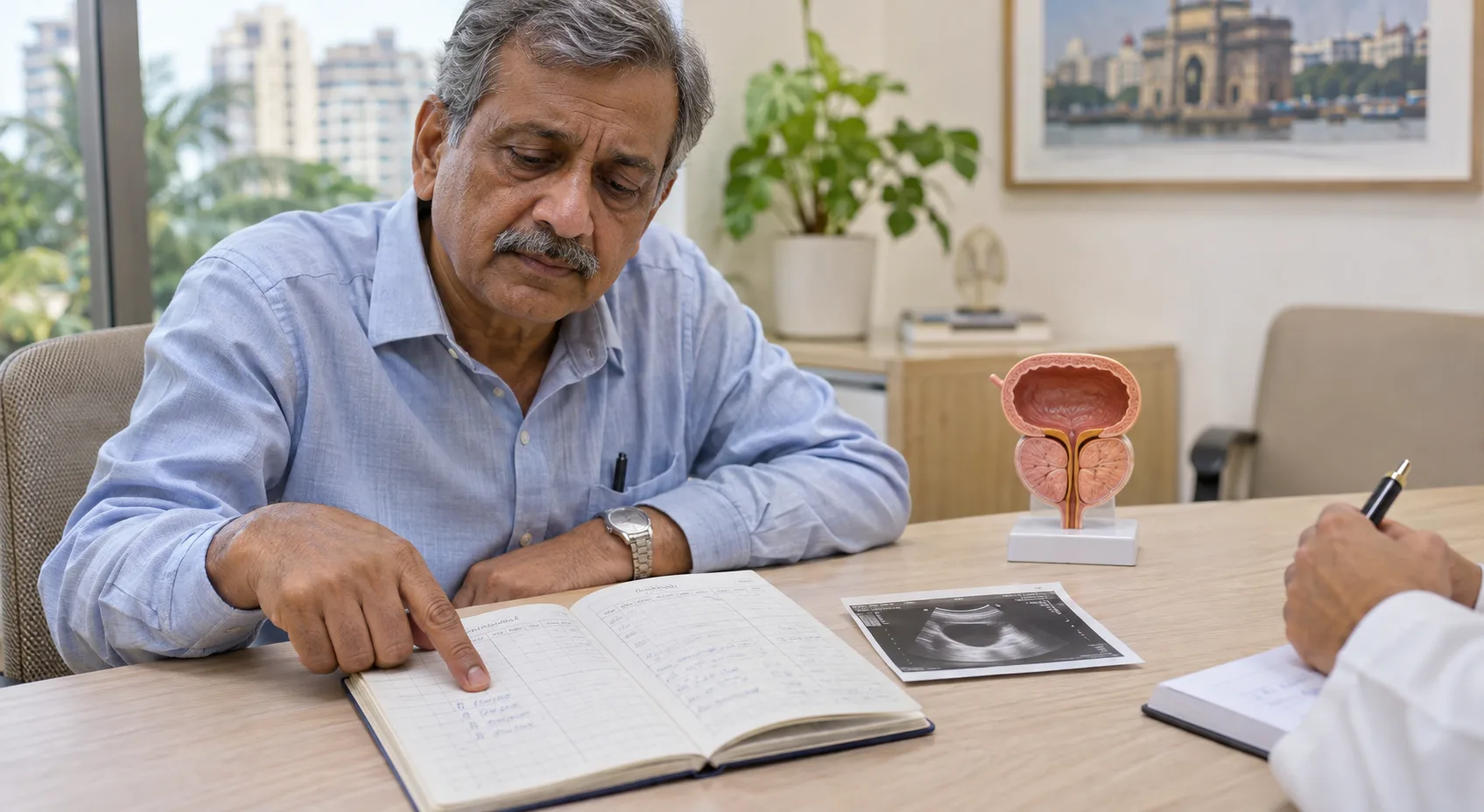
Consider what bothers you most. A man who strains to start every stream has a different concern from someone who passes a good stream but wakes four times each night. In the second situation, a bladder diary can help show whether the body produces a large amount of urine overnight. Opening the prostate channel may improve flow while leaving some night-time trips unchanged.
How does a urologist choose between TURP and laser surgery?
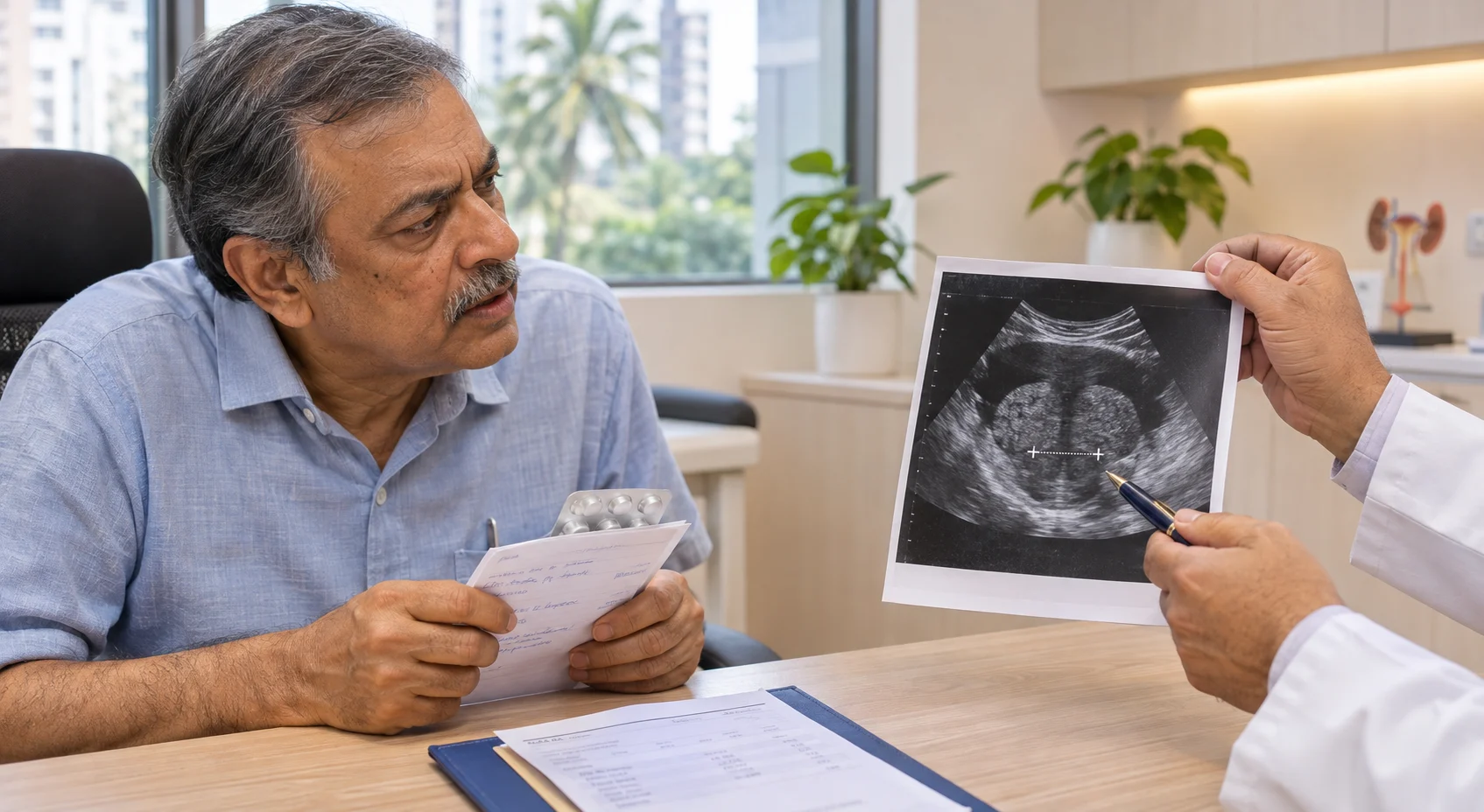
If the ultrasound says 55 mL: TURP and laser procedures may all be reasonable. The next questions are how much urine stays in the bladder after you pass urine, which symptoms you want to improve and what risks matter most to you. Ask why the surgeon recommends one method in your case.
If the ultrasound says 110 mL: HoLEP is an established option for a gland this size when a surgeon experienced in the technique is available. It removes the enlarged inner portion along its natural boundary. For a large gland, ask how thoroughly each proposed procedure can relieve the obstruction and how likely you are to need another procedure later.
If you take a blood thinner: Tell the urologist the medicine’s name and why you take it. The bleeding profile of a laser procedure may influence the recommendation. Your surgical team and the clinician who prescribed the medicine should agree on when to take it around surgery. Continue to follow your prescribed plan until they give you specific instructions.
If a PSA result is being investigated: Ask whether you need further assessment before BPH surgery. TURP and HoLEP provide tissue for examination, but they sample only the tissue removed. A benign result cannot rule out cancer elsewhere in the prostate.
What is recovery like after TURP or laser prostate surgery?
A temporary catheter drains the bladder after surgery. Before you go home, ask when it will come out, who will remove it and whom to contact if it stops draining. Some patients go home with the catheter still in place.
Once the catheter comes out, the stream may feel stronger before the bladder feels settled. Burning, urgency and lightly blood-stained urine can occur during healing. Temporary leakage can happen, particularly early after HoLEP. Tell your team if leakage persists or interferes with daily activities.
After TURP, many people return to usual activities in two to four weeks, although full healing can take around six weeks. Some laser procedures allow earlier catheter removal or discharge. If your work involves lifting, ask for a separate return-to-work date even if you already feel comfortable walking or doing desk work.
Seek urgent medical care if you suddenly cannot pass urine, your catheter stops draining and your lower abdomen feels full or painful, or you develop heavy bleeding, large clots, fever or chills.
Frequently asked questions
What to ask before you decide
Ask your urologist, “Given my prostate size and bladder test results, which symptom do you expect this operation to improve most?” Then ask why they favour that particular technique, when the catheter is likely to come out and what changes to expect with ejaculation. Those answers give you a more personal basis for deciding between TURP, HoLEP and GreenLight surgery.
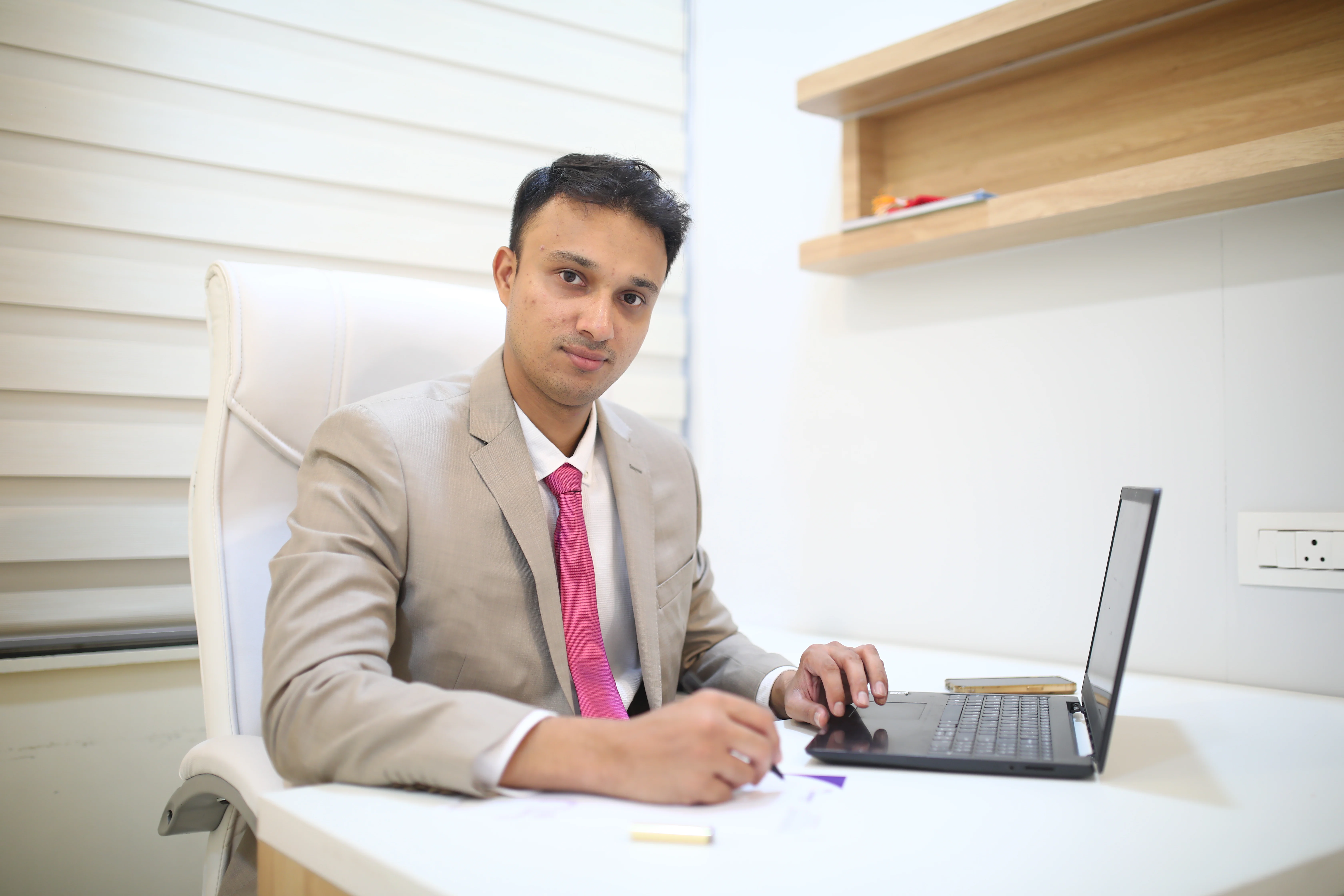
About Dr. Shyam Mohan
Consultant Urologist, Uro-Oncologist & Robotic Surgeon
Dr. Shyam Mohan holds recognised medical qualifications including MBBS, MS (General Surgery), and MCh (Urology), along with a specialized Fellowship in Advanced Robotic Uro-Oncology.
His clinical practice focuses on prostate health, advanced laser and endoscopic procedures, robotic surgery, and comprehensive urological care at Synergy Health Clinic in Chembur, Mumbai.